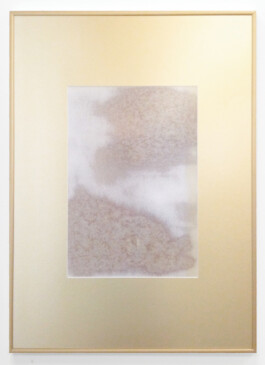
Tom Van Puyvelde
Selected by
Koen van den Broek
INDEX

Tom Van Puyvelde, INDEX, 2026, oil on wood, 49,8 x 78,2 x 9,2 cm (open), 49,8 x 40,4 x 5,3 cm (closed), Installation view at Jacobs' Booth, Antwerp
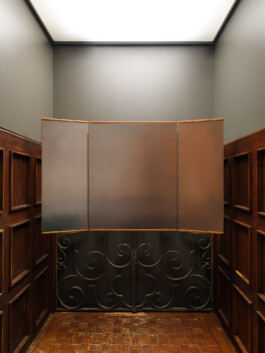
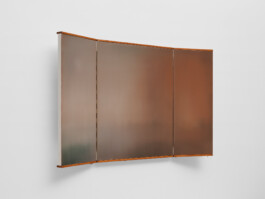
For its fourth presentation the Booth presents Tom Van Puyvelde, selected by Koen van den Broek, with a single new in-situ triptych, built to the exact dimensions of the booth and conceived to operate in two states: open or closed. That binary mechanism is the work’s centre of gravity.
Open, the triptych presents three painted panels of slow chromatic transition: a passage between states held still long enough to be seen. Its source is The Last Judgement by Hieronymus Bosch (c. 1500), held a short distance away in the Groeningemuseum in Bruges and listed as a Flemish Topstuk or Masterpiece. For five centuries this winged altarpiece has set the visual grammar by which Northern art imagines the world’s end: paradisiacal landscape on the left, Christ in a mandorla flanked by trumpeting angels at the centre, a burning city to the right. Van Puyvelde does not quote that grammar. He indexes it.

Tom Van Puyvelde, INDEX, 2026, oil on wood, 49,8 x 78,2 x 9,2 cm (open), 49,8 x 40,4 x 5,3 cm (closed), Installation view at Jacobs' Booth, Antwerp
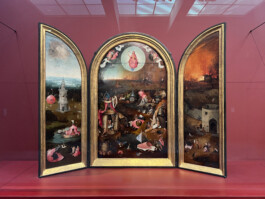
Hieronymus Bosch (c. 1450–1516), Last Judgement (triptych), c. 1500, oil on panel, Groeningemuseum, Bruges.
Picture taken by the artist, 2025.
Bosch Stretched
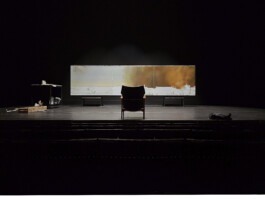
The new triptych belongs to a body of work Van Puyvelde calls Elongation: a series of horizontally extended panels in which gradients carry the weight of the composition. The series began in early 2025 at the Concertgebouw in Bruges, where Van Puyvelde painted Elongation I across the full thirty-six hours of Slow(36h). In the final hour, the triptych was blended live before an audience in the main hall, accompanying a digitally engineered cello performance by Arne Deforce. The fact matters. Less than a kilometre from the Bosch in the Groeningemuseum, the painting was made not from a digital reproduction but in the same city as its source, in a setting that rendered the act of painting closer to music than to studio work.

Tom Van Puyvelde, Elongation, 2025, Concertgebouw Brugge
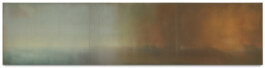
The handling recalls Gerhard Richter, whose squeegee abstractions, dragged across the canvas in pulls of paint, produced an image in which the depicted thing and the act of depicting could no longer be distinguished. Van Puyvelde takes from this the conviction that a landscape can be the trace of how it was painted, not a representation of something seen elsewhere. This binding of “abstract” and “figurative” until each loses its independent footing is the operation Domenico de Chirico described in his text on Van Puyvelde’s Spectrum: a dialectic that “becomes ferocious to the point of annihilation,” in which “the two opposites lose each other’s consistency in a movement of tension that attracts them to each other.” The Booth triptych extends that movement to a five-hundred-year-old source.

Tom Van Puyvelde, Elongation I, 2025, oil on canvas, 150 x 630 cm
Indexing as a method since 2014
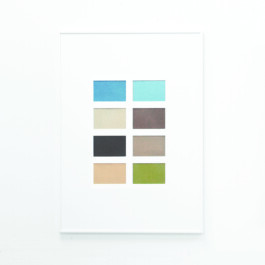
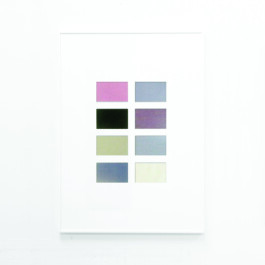
What is more difficult to see at first encounter, and what changes the reading once seen, is that Van Puyvelde has been working with the procedure of indexing for more than a decade. Notes, his graduation work for the School of Arts Ghent in 2014 under the supervision of Jan Debbaut and Vincent Geyskens, included a wall installation of 39 cardboard panels carrying 117 panini NBA stickers, collected in his childhood, overpainted with monochrome oil paint rectangles: the common denominator of the underlying figurative image. Notes about colour, he called them. From the same year, Pamukkale Sundown, Black Barn and Rusty Barn take the procedure outside the album. Each motif is dismantled into a grid of pigment samples without the original image.


Tom Van Puyvelde, Black Barn, 2014, oil on paper, 42 x 29,7 cm (70 x 50 cm framed)

Tom Van Puyvelde, Pammukale Sundown, 2014, oil on paper, 42 x 29,7 cm (70 x 50 cm framed)
Van Puyvelde has therefore been doing for twelve years what looks, in the Booth, like a sudden conceptual gesture.

Tom Van Puyvelde, INDEX, 2026, oil on wood, 49,8 x 40,4 x 5,3 cm (closed)

Tom Van Puyvelde, INDEX, 2026, oil on wood, 49,8 x 78,2 x 9,2 cm (open)
The Booth triptych is not a sudden turn toward the late-medieval, nor an opportunistic engagement with Flemish heritage. The subject of his paintings does not always particularly seem of much importance, which is why he tends to choose ordinary ones. What follows from that proposition is the entire shape of his practice. The basketball card, the barn and a fifteenth-century Flemish altarpiece are interchangeable in one respect: they are the occasion, not the content, of the painting. What is painted is what happens to colour once the occasion has been accepted; the search for nuance, gradient, the spectrum of light and darkness, performed on whatever motif comes to hand. In that sense the pigment chart is not a commentary on the painting; it is a parallel form of the painting, and at times its replacement.

Index (Crépuscule) I, 2022, oil on canvas, 30x33 cm
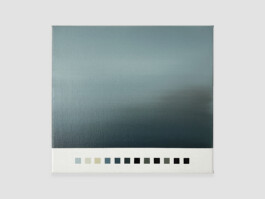
The configuration first appeared on a single canvas during Van Puyvelde's 2022 residency at Chambre avec vue in Saignon, in a work he titled Index (Crépuscule) I, a dusk image held above the pigments from which it had been built. Index (Elongation) I (2026), which gives the exhibition its name, restates that structure in intimate scale: a painted Elongation above a row of eighteen colour samples. The Booth triptych enlarges the same two-part structure to the dimensions of an altarpiece.

That enlargement does something the earlier work did not. Where the indexed works of 2014 were static panels on a wall, the Booth triptych opens and closes on hinges and is built to the booth’s exact dimensions. The site-specific impulse runs through Van Puyvelde’s recent practice, but here, for the first time, it becomes structural, existing between painting and sculpture.
Architecture, for both Van Puyvelde and Van den Broek, is not the subject of the painting but its precondition.
Koen van den Broek
Koen van den Broek’s selection of Van Puyvelde is not a senior painter doing a younger painter a favour. It is a recognition. Both artists trained first as architects and only afterwards turned to painting; both have spent the years since reducing what they paint to the lines, planes and pigments that organise it.
Van den Broek's twenty-five-year career has concerned itself with thresholds: borders, curbs, cracks, the painted markings and edges that organise the American built environment. John C. Welchman's recent monograph Out of Place (MER. B&L, 2023) places that concern within a longer postwar genealogy, setting Robert Motherwell's Open series and Kenneth Noland’s stripes beside Van den Broek's early border paintings. Welchman makes visible what is rarely given its proper weight: that Van den Broek's borders are not only documentary observations of road infrastructure. They are the latest term in a sequence of works that test how far representation can be reduced to a single pigmented edge.

Robert Motherwell, Open No. 49, 1969. Acrylic on canvas, 76.2 × 101.6 cm

Koen van den Broek, Orange and Black Border, 2001. Oil on canvas, 70 × 46 cm

Kenneth Noland, Little Rouge, 1969. Acrylic on canvas, 125.7 × 261.9 cm. Christie's image
Two earlier projects of van den Broek stand close to what Van Puyvelde does in the Booth. The first is Madonna (2010, Collection M HKA), in which Van den Broek reduced Jean Fouquet’s Madonna Surrounded by Seraphim and Cherubim (1454-56, KMSKA Antwerp) to a configuration of red and blue cherubim around the negative-space silhouette of mother and child — a diagrammatic distillation of a contrast already present in Fouquet, whose red-blue-off-white coordinates were, by 2010, recognisable as the colour scheme van den Broek had been working with for a decade in his American Borders. Welchman describes the dialogue with Fouquet as part of an enduring tradition of colour-clarification with which the painter willingly identifies. The second precedent is the collaboration This an Example of That (2008) with John Baldessari, in which painted monochrome shapes were laid over archival photographs as commentaries on their formal and material constitution.

Koen Van den Broek, Madonna, 2010, oil on canvas, 93 x 85 cm, Collection M HKA, Antwerp

Jean Fouquet, Madonna Surrounded by Seraphim and Cherubim, c. 1452, oil on oak panel, 94.5 × 85.5 cm, KMSKA, Antwerp.

Koen van den Broek & John Baldessari, This an Example of That #3, Interior With Fireplace, 2008, 332 x 420 cm

Koen van den Broek & John Baldessari, This an Example of That #52- The Learning Tree (Winger Dining Room), 2008, 174 x 220 cm
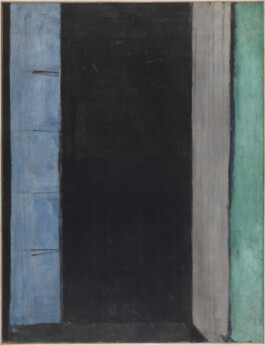
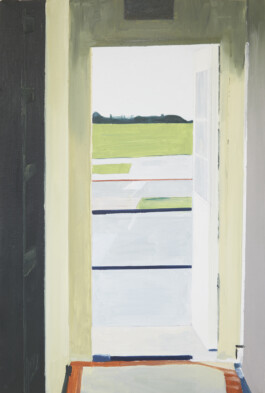
Among the motifs that recur across that genealogy, one returns more often than the others: the open window. From Exit (2000) through Blinds #6 (2021), van den Broek has referenced Matisse's open window in his own vocabulary repeatedly as the mediated edge between an interior and what lies beyond.

Henri Matisse, Porte-fenêtre à Collioure, 1914, oil on canvas, 116.5 × 89 cm, Centre Pompidou, Paris.

Koen van den Broek, Exit, 2000, oil on canvas, 105 x 70 cm

Koen van den Broek, Blinds #6, 2021, 180 x 120 cm
The Booth itself, with its 1950 grille opening to a triptych that is also a window, is the architecture in which that motif now finds Van Puyvelde’s. What was a recurring concern for van den Broek becomes, for the duration of the exhibition, a literal frame.


To set the Bosch-derived triptych of INDEX alongside these precedents is to recognise that van den Broek is not curating Van Puyvelde from outside. Madonna (2010) performs that operation on Antwerp’s Fouquet. INDEX (2026) performs that operation on Bruges’s Bosch. The two projects close a circuit between two of the principal Flemish Primitives held in Belgian public collections, generations apart, by way of two artists who never depict figures so much as map the pigments by which figures once cohered.
A further note belongs here. In 2014, Van den Broek produced his monumental four-panel cycle Players / Guard / Goal / Lautner, exhibited as The Land of Milk and Money, with a commissioned poem by Frank Albers. Albers reads the cycle as an arc that runs from Genesis to the Apocalyptic, organised by gates, fences and absent guards. The Boschian grammar of threshold and judgement, in other words, was already at work in van den Broek’s painting a decade before his selection.

Koen van den Broek, Players / Guard / Goal / Lautner
2014, oil on canvas, 266 x 400 cm


The Grid Underneath
There is a final layer, and it is what gives the closed state of the triptych its force.
In her 1979 essay Grids, Rosalind Krauss argued that the modernist grid is a structure that does the work of myth: it allows two otherwise incompatible ideas, material science and spiritual longing, to coexist without resolution. Its sources, she showed, are double. On the one hand, the nineteenth-century treatise on physiological optics, with its modular charts of complementary colour. On the other, the Symbolist window — Mallarmé’s Les Fenêtres (1863), Redon’s Le Jour (1891) — in which the glass pane both transmits and reflects, both opens and freezes.
As Krauss puts it, behind every twentieth-century grid lies “a symbolist window parading in the guise of a treatise on optics.”

Tom Van Puyvelde, INDEX, 2026, oil on wood, 49,8 x 40,4 x 5,3 cm (closed)
The closed state of Van Puyvelde’s Booth triptych takes that argument almost literally. Twenty pigment fields, arranged in two rows, calibrated to the painted Bosch landscapes that lie behind them, a chart of complementary colour mounted within the frame of a wrought-iron window. Bosch’s altarpiece, when shut, presents grisaille; this triptych, when shut, presents the index. What in the late-medieval grammar was concealed (the chromatic vision) is here isolated and analysed; what was revealed (the figured cosmology) is folded away. When the panels open, the relation reverses: colour returns to figure, figure dissolves into atmosphere. Both states are reductions. Both refuse the overwhelming the original Bosch was constructed to deliver.

Hieronymus Bosch (c 1450–1516), The Last Judgment (exterior, Crowning with Thorns) (c 1495-1505)

Tom Van Puyvelde, Untitled, 2014, oil on paper, 42 x 29,7 cm (70 x 50 cm framed)
There is a second resonance with Bosch that the closed Booth makes legible. The exterior of the Last Judgement, when shut, depicts the Crowning with Thorns in grisaille on a black ground — but five centuries of damage have reduced even that scene to drifts and stains, the figure of Christ visible only in fragments where the paint still holds. The exterior is, at this point, almost an oxidation: a record of what has happened to pigment in the absence of a viewer. In 2014, the same year as Notes, Van Puyvelde produced his Oxidation works on paper. Each small panel was painted in Residu — a homogeneous mixture of the leftover paint from a single studio session, titled by the date of that day, like a diary page of colour. Over time the verso became the more compelling surface: the oil binding with the paper, oxidising, slowly yellowing. The works remain in continuous transformation. Set beside Bosch's worn shutters, they begin to read as a second indexing, not of the colour of a painting but of what time and chemistry continue to do to it.
The closed state of Van Puyvelde’s Booth triptych holds both: the index of the painted vision behind it, and the trace of an attention to pigment as a substance that lives, ages and fails outside the painter’s will.

Tom Van Puyvelde, INDEX, 2016 (study)
Looking
The passers-by who will encounter the work will see it through a sequence of mediations: the case glass, the 1950 wrought-iron grille, the outer or inner face of the panels themselves. Whether the panels stand open or closed at the moment of passing, what they meet is not a picture of the Apocalypse but its measurement, twenty pigments, three panels, one window, held within an architecture that, in its modest scale, is closer to a side-chapel altar than to an art-fair stand. Bosch is not in the Booth. What is in the Booth is the residue of looking, and the conditions under which that looking might still be possible.

Tom Van Puyvelde, INDEX, 2026, oil on wood, 49,8 x 78,2 x 9,2 cm (open), Installation view at Jacobs' Booth, Antwerp
To learn more about this work and Jacobs’ Booth
CONTACT US
Tom Van Puyvelde
Selected by
Koen van den Broek
INDEX

Tom Van Puyvelde, INDEX, 2026, oil on wood, 49,8 x 78,2 x 9,2 cm (open), 49,8 x 40,4 x 5,3 cm (closed)
Installation view at Jacobs' Booth, Antwerp
For its fourth presentation the Booth presents Tom Van Puyvelde, selected by Koen van den Broek, with a single new in-situ triptych, built to the exact dimensions of the booth and conceived to operate in two states: open or closed. That binary mechanism is the work’s centre of gravity.
Open, the triptych presents three painted panels of slow chromatic transition: a passage between states held still long enough to be seen. Its source is The Last Judgement by Hieronymus Bosch (c. 1500), held a short distance away in the Groeningemuseum in Bruges and listed as a Flemish Topstuk or Masterpiece. For five centuries this winged altarpiece has set the visual grammar by which Northern art imagines the world’s end: paradisiacal landscape on the left, Christ in a mandorla flanked by trumpeting angels at the centre, a burning city to the right. Van Puyvelde does not quote that grammar. He indexes it.

Tom Van Puyvelde, INDEX, 2026, oil on wood, 49,8 x 78,2 x 9,2 cm (open), 49,8 x 40,4 x 5,3 cm (closed), Installation view at Jacobs' Booth, Antwerp

Hieronymus Bosch (c. 1450–1516), Last Judgement (triptych), c. 1500, oil on panel, Groeningemuseum, Bruges.
Picture taken by the artist, 2025.
Bosch Stretched
The new triptych belongs to a body of work Van Puyvelde calls Elongation: a series of horizontally extended panels in which gradients carry the weight of the composition. The series began in early 2025 at the Concertgebouw in Bruges, where Van Puyvelde painted Elongation I across the full thirty-six hours of Slow(36h). In the final hour, the triptych was blended live before an audience in the main hall, accompanying a digitally engineered cello performance by Arne Deforce. The fact matters. Less than a kilometre from the Bosch in the Groeningemuseum, the painting was made not from a digital reproduction but in the same city as its source, in a setting that rendered the act of painting closer to music than to studio work.

Tom Van Puyvelde, Elongation, 2025, Concertgebouw Brugge
The handling recalls Gerhard Richter, whose squeegee abstractions, dragged across the canvas in pulls of paint, produced an image in which the depicted thing and the act of depicting could no longer be distinguished. Van Puyvelde takes from this the conviction that a landscape can be the trace of how it was painted, not a representation of something seen elsewhere. This binding of “abstract” and “figurative” until each loses its independent footing is the operation Domenico de Chirico described in his text on Van Puyvelde’s Spectrum: a dialectic that “becomes ferocious to the point of annihilation,” in which “the two opposites lose each other’s consistency in a movement of tension that attracts them to each other.” The Booth triptych extends that movement to a five-hundred-year-old source.

Tom Van Puyvelde, Elongation I, 2025, oil on canvas, 150 x 630 cm
Indexing as a method since 2014
What is more difficult to see at first encounter, and what changes the reading once seen, is that Van Puyvelde has been working with the procedure of indexing for more than a decade. Notes, his graduation work for the School of Arts Ghent in 2014 under the supervision of Jan Debbaut and Vincent Geyskens, included a wall installation of 39 cardboard panels carrying 117 panini NBA stickers, collected in his childhood, overpainted with monochrome oil paint rectangles: the common denominator of the underlying figurative image. Notes about colour, he called them. From the same year, Pamukkale Sundown, Black Barn and Rusty Barn take the procedure outside the album. Each motif is dismantled into a grid of pigment samples without the original image.


Tom Van Puyvelde, Black Barn, 2014, oil on paper, 42 x 29,7 cm (70 x 50 cm framed)
Tom Van Puyvelde, Pammukale Sundown, 2014, oil on paper, 42 x 29,7 cm (70 x 50 cm framed)
Van Puyvelde has therefore been doing for twelve years what looks, in the Booth, like a sudden conceptual gesture.


The Booth triptych is not a sudden turn toward the late-medieval, nor an opportunistic engagement with Flemish heritage. The subject of his paintings does not always particularly seem of much importance, which is why he tends to choose ordinary ones. What follows from that proposition is the entire shape of his practice. The basketball card, the barn and a fifteenth-century Flemish altarpiece are interchangeable in one respect: they are the occasion, not the content, of the painting. What is painted is what happens to colour once the occasion has been accepted; the search for nuance, gradient, the spectrum of light and darkness, performed on whatever motif comes to hand. In that sense the pigment chart is not a commentary on the painting; it is a parallel form of the painting, and at times its replacement.

Index (Crépuscule) I, 2022, oil on canvas, 30x33 cm
The configuration first appeared on a single canvas during Van Puyvelde's 2022 residency at Chambre avec vue in Saignon, in a work he titled Index (Crépuscule) I, a dusk image held above the pigments from which it had been built. Index (Elongation) I (2026), which gives the exhibition its name, restates that structure in intimate scale: a painted Elongation above a row of eighteen colour samples. The Booth triptych enlarges the same two-part structure to the dimensions of an altarpiece.

That enlargement does something the earlier work did not. Where the indexed works of 2014 were static panels on a wall, the Booth triptych opens and closes on hinges and is built to the booth’s exact dimensions. The site-specific impulse runs through Van Puyvelde’s recent practice, but here, for the first time, it becomes structural.
Architecture, for both Van Puyvelde and Van den Broek, is not the subject of the painting but its precondition.
Koen van den Broek
Koen van den Broek’s selection of Van Puyvelde is not a senior painter doing a younger painter a favour. It is a recognition. Both artists trained first as architects and only afterwards turned to painting; both have spent the years since reducing what they paint to the lines, planes and pigments that organise it.
Van den Broek's twenty-five-year career has concerned itself with thresholds; borders, curbs, cracks, the painted markings and edges that organise the American built environment. John C. Welchman's recent monograph Out of Place (MER. B&L, 2023) places that concern within a longer postwar genealogy, setting Robert Motherwell's Open series and Kenneth Noland’s stripes beside Van den Broek's early border paintings. Welchman makes visible what is rarely given its proper weight: that Van den Broek's borders are not only documentary observations of road infrastructure. They are the latest term in a sequence of works that test how far representation can be reduced to a single pigmented edge.

Robert Motherwell, Open No. 49, 1969. Acrylic on canvas, 76.2 × 101.6 cm

Koen van den Broek, Orange and Black Border, 2001. Oil on canvas, 70 × 46 cm

Kenneth Noland, Little Rouge, 1969. Acrylic on canvas, 125.7 × 261.9 cm. Christie's image
Two earlier projects of van den Broek stand close to what Van Puyvelde does in the Booth. The first is Madonna (2010, Collection M HKA), in which Van den Broek reduced Jean Fouquet’s Madonna Surrounded by Seraphim and Cherubim (1454-56, KMSKA Antwerp) to a configuration of red and blue cherubim around the negative-space silhouette of mother and child, a diagrammatic distillation of a contrast already present in Fouquet, whose red-blue-off-white coordinates were, by 2010, recognisable as the colour scheme van den Broek had been working with for a decade in his American Borders. Welchman describes the dialogue with Fouquet as part of an enduring tradition of colour-clarification with which the painter willingly identifies. The second precedent is the collaboration This an Example of That (2008) with John Baldessari, in which painted monochrome shapes were laid over archival photographs as commentaries on their formal and material constitution.

Koen Van den Broek, Madonna, 2010, oil on canvas, 93 x 85 cm, Collection M HKA, Antwerp

Jean Fouquet, Madonna Surrounded by Seraphim and Cherubim, c. 1452, oil on oak panel, 94.5 × 85.5 cm, KMSKA, Antwerp.

Koen van den Broek & John Baldessari, This an Example of That #3, Interior With Fireplace, 2008, 332 x 420 cm

Koen van den Broek & John Baldessari, This an Example of That #52- The Learning Tree (Winger Dining Room), 2008, 174 x 220 cm
Among the motifs that recur across that genealogy, one returns more often than the others: the open window. From Exit (2000) through Blinds #6 (2021), van den Broek has referenced Matisse's open window in his own vocabulary repeatedly as the mediated edge between an interior and what lies beyond.

Henri Matisse, Porte-fenêtre à Collioure, 1914, oil on canvas, 116.5 × 89 cm, Centre Pompidou, Paris.

Koen van den Broek, Exit, 2000, oil on canvas, 105 x 70 cm

Koen van den Broek, Blinds #6, 2021, 180 x 120 cm
The Booth itself, with its 1950 grille opening to a triptych that is also a window, is the architecture in which that motif now finds Van Puyvelde’s. What was a recurring concern for van den Broek becomes, for the duration of the exhibition, a literal frame.


To set the Bosch-derived triptych of INDEX alongside these precedents is to recognise that van den Broek is not curating Van Puyvelde from outside. Madonna (2010) performs that operation on Antwerp’s Fouquet. INDEX (2026) performs that operation on Bruges’s Bosch. The two projects close a circuit between two of the principal Flemish Primitives held in Belgian public collections, generations apart, by way of two artists who never depict figures so much as map the pigments by which figures once cohered.
A further note belongs here. In 2014, Van den Broek produced his monumental four-panel cycle Players / Guard / Goal / Lautner, exhibited as The Land of Milk and Money, with a commissioned poem by Frank Albers. Albers reads the cycle as an arc that runs from Genesis to the Apocalyptic, organised by gates, fences and absent guards. The Boschian grammar of threshold and judgement, in other words, was already at work in van den Broek’s painting a decade before his selection.


Koen van den Broek, Players / Guard / Goal / Lautner, 2014, oil on canvas, 266 x 400 cm

The Grid Underneath
There is a final layer, and it is what gives the closed state of the triptych its force.
In her 1979 essay Grids, Rosalind Krauss argued that the modernist grid is a structure that does the work of myth: it allows two otherwise incompatible ideas, material science and spiritual longing, to coexist without resolution. Its sources, she showed, are double. On the one hand, the nineteenth-century treatise on physiological optics, with its modular charts of complementary colour. On the other, the Symbolist window — Mallarmé’s Les Fenêtres (1863), Redon’s Le Jour (1891) — in which the glass pane both transmits and reflects, both opens and freezes.
As Krauss puts it, behind every twentieth-century grid lies “a symbolist window parading in the guise of a treatise on optics.”

Tom Van Puyvelde, INDEX, 2026, oil on wood, 49,8 x 40,4 x 5,3 cm (closed)
The closed state of Van Puyvelde’s Booth triptych takes that argument almost literally. Twenty pigment fields, arranged in two rows, calibrated to the painted Bosch landscapes that lie behind them, a chart of complementary colour mounted within the frame of a wrought-iron window. Bosch’s altarpiece, when shut, presents grisaille; this triptych, when shut, presents the index. What in the late-medieval grammar was concealed (the chromatic vision) is here isolated and analysed; what was revealed (the figured cosmology) is folded away. When the panels open, the relation reverses: colour returns to figure, figure dissolves into atmosphere. Both states are reductions. Both refuse the overwhelming the original Bosch was constructed to deliver.

Hieronymus Bosch (c 1450–1516), The Last Judgment (exterior, Crowning with Thorns) (c 1495-1505)

There is a second resonance with Bosch that the closed Booth makes legible. The exterior of the Last Judgement, when shut, depicts the Crowning with Thorns in grisaille on a black ground — but five centuries of damage have reduced even that scene to drifts and stains, the figure of Christ visible only in fragments where the paint still holds. The exterior is, at this point, almost an oxidation: a record of what has happened to pigment in the absence of a viewer. In 2014, the same year as Notes, Van Puyvelde produced his Oxidation works on paper. Each small panel was painted in Residu — a homogeneous mixture of the leftover paint from a single studio session, titled by the date of that day, like a diary page of colour. Over time the verso became the more compelling surface: the oil binding with the paper, oxidising, slowly yellowing. The works remain in continuous transformation. Set beside Bosch's worn shutters, they begin to read as a second indexing, not of the colour of a painting but of what time and chemistry continue to do to it.
The closed state of Van Puyvelde’s Booth triptych holds both: the index of the painted vision behind it, and the trace of an attention to pigment as a substance that lives, ages and fails outside the painter’s will.

Tom Van Puyvelde, INDEX, 2016 (study)
Looking
The passers-by who will encounter the work will see it through a sequence of mediations: the case glass, the 1950 wrought-iron grille, the outer or inner face of the panels themselves. Whether the panels stand open or closed at the moment of passing, what they meet is not a picture of the Apocalypse but its measurement, twenty pigments, three panels, one window, held within an architecture that, in its modest scale, is closer to a side-chapel altar than to an art-fair stand. Bosch is not in the Booth. What is in the Booth is the residue of looking, and the conditions under which that looking might still be possible.

Tom Van Puyvelde, INDEX, 2026, oil on wood, 49,8 x 78,2 x 9,2 cm (open), Installation view at Jacobs' Booth, Antwerp
To learn more about this work and Jacobs’ Booth
CONTACT US
2026 © Jacobs' Booth